
SD Protection
ESD Workbenches & Stations
Ergonomic Solutions for Increased Productivity and Employee Safety
Prevent ESD Damage and Ensure Quality
Electrostatic discharge (ESD) occurs when differently charged objects are brought in close proximity or contact. It could cause damage to sensitive electronics components and lead to immediate or delayed product failures.
BOSTONtec’s ESD workbench is an integral part of an ESD protected area (EPA) to prevent ESD damages and costly consequences. It combines ESD safety with ergonomics to ensure product quality, employee well-being, and productivity improvement.
For helpful insights, read our Complete ESD Workbench Guide.
Key benefits :
- Prevent product defects and device failures due to damages of sensitive electronics components
- Safeguard company reputation and avoid substantial legal cost related to product quality issues
- Reduce reaching, bending, and twisting associated with electronics assembly and testing tasks
- Improve efficiency by reducing non-value added motions
- Enhance employee satisfaction and morale with ergonomically optimized work space
- Adapt to changes in workforces and work processes easily with modular design and setup
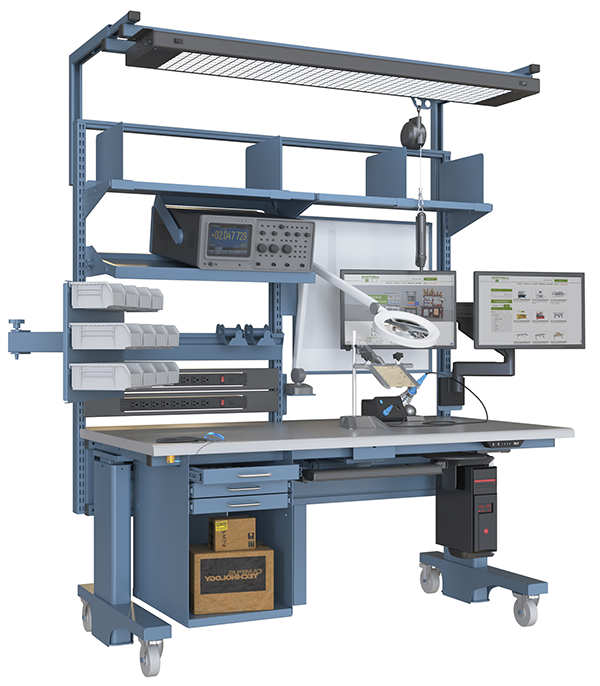
additional lighting directly over
work surface.
ergonomic support.
Monitor Arm provides optimum
flexibility to move both monitors
into position.
access to ports, drives, and cables.
unique drop down foot design
which adds casters without
increasing starting height of
the workstation.
compartments for tool storage.
durable with impact resistant
edges.
keeps small items sorted
and within the proper reach.
allows easy adjustment for
visibility and accessibility of
tools and devices.
wrist strap.
Tray with Sliding Mouse Platform
allows operator to access
keyboard and mouse as needed
then store under work surface
when not in use.

additional lighting directly over
work surface.
ergonomic support.
Monitor Arm provides optimum
flexibility to move monitors
into position.
access to ports, drives, and cables.
unique drop down foot design
which adds casters without
increasing starting height of
the workstation.
compartments for tool storage.
durable with impact resistant
edges.
keeps small items sorted
and within the proper reach.
allows easy adjustment for
visibility and accessibility of
tools and devices.
wrist strap.
Tray with Sliding Mouse Platform
allows operator to access
keyboard and mouse as needed
then store under work surface
when not in use.
Preconfigured ESD Workstations
Pick a starting point. Edit in the configurator or request a quote as-is.
Don't see the right fit?
Our team can design a custom workstation around your specific workflow, tools, and space requirements.
5 Simple Steps to Build Your ESD Workstation
- STEP 1 - Enter The 3D Workstation Builder
- STEP 2 - Select Base Frame
- STEP 3 - Select Feet or Caster Type
- STEP 4 - Select Work Surface Type
- STEP 5 - Select Accessories
Click here to enter our 3D workstation configurator. Once inside you can configure a custom workbench to your specific needs!

Select Your Workbench Base Frame
What you need to consider when choosing a workstation frame for an ESD application:
- The size of the frame is dependent on the size of the work surface. Decide how much surface is necessary to perform the ESD tasks – and how much space is available in the work area. Apply the ergonomic reach zones to each item or function. The space should be large enough to perform the ESD tasks but compact to limit reaching and stretching.
- What is the maximum capacity required, including shelving, equipment, and components? Is the weight distributed evenly? Excessive weight in one area of a workstation could require a higher capacity frame.
- Will there be multiple users of the workstation? Will the operator transition between sitting and standing? Here is a good rule-of-thumb to determine whether to choose manual or electric height adjustability: Electric adjustability is a better choice if the height needs to be adjusted more than four times per year.

Select Feet or Caster Type
Some important considerations for choosing the feet or casters for ESD workbenches:
- How often will the workstation be moved within the work area? Leveler feet are used for primarily stationary units. Casters are recommended for stations that will be occasionally or frequently moved or repositioned. For safety, BOSTONtec offers workstations with at least two locking casters; all four locking casters are available for additional security.
- Special static dissipative ESD casters are needed for ESD protection. They have a polyolefin core with conductive rubber tread. They allow the static electricity to flow through and release into flooring when the station is in movement.
- Evaluate the distribution of the load the station will support and any force that could affect unit’s stability. Lag plates are an option that attach to standard leveler feet allowing the workstation to be bolted to the floor.

Select Work Surface Type
Here are some essential considerations for choosing the correct work surface for an ESD application:
- How much surface is necessary to perform the ESD tasks? How much space is available in the work area? Assign each item or function to appropriate ergonomic reach zones for proper ergonomics and optimized performance. The space should be large enough to perform the ESD tasks but compact to limit reaching and stretching.
- ESD work surface is a must-have to protect the sensitive electronics components and devices from damage by sudden electric discharge. It utilizes a special electrostatic dissipative laminate that diffuses static electricity and reduces electric current transfer on the work surface. Flush ESD grounding bolt is installed in the work surface to ground the station. Wrist strap is connected to the swivet connector to keep the wearer at a low electrical potential at all times.
- Lastly, think about how the user will perform most functions. Is it from a sitting or standing position? A rolled front edge is more ergonomic for operators who rest their forearms on the front edge of the work surface when performing a task.

Select Accessories for ESD Workbenches:
Once the basic components of the ESD workbench are selected, accessories are added to place items based on frequency and sequence of use, safety and other factors to reduce operator stress and increase productivity. (See Plan Your Workstation for more information)
- Review the ergonomic reach zones and think about what tools and components correspond with each zone. Utilizing uprights with shelves and bin rails allows the operator to place items where appropriate while keeping the work surface clear for tasks.
- Is there enough lighting where the workstation will be placed? For detailed electronics assembly and testing tasks, additional lighting may be necessary to reduce eye strain and avoid accidents. For meticulous work, special task lights or magnifiers are also helpful.
- The operator will be using powered tools and devices. Placing a power strip close to the work surface makes access to tools and equipment simple and easy. It avoids bending or stretching to reach outlets.
Custom ESD Workstations
When is it right for you?
While modular workstations offer versatility for many workflows, custom ESD workstations deliver the specialized features your team needs for specific environments.
A custom ESD workstation can range from a simple static-dissipative surface to a fully equipped multi-station configuration. Start with our modular system, then refine each component to protect sensitive electronics, enhance productivity, and support employee retention.

Discover the ROI of Ergonomic ESD Workbenches
Unlock measurable productivity gains and reduce injury-related costs at your ESD workstations by investing in ergonomic, static-safe designs.
A study by the Ergonomics Center at North Carolina State University found that ergonomic workstations deliver shorter cycle times, more value-added motions, and fewer opportunities for injury—benefits that directly support electronics assembly, testing, repair, and component handling.
With our Ergonomics ROI Calculator, you can see exactly how an investment in ergonomic ESD stations pays off for your operation.
Try it now to estimate the savings and efficiency gains from reducing repetitive motions, minimizing injury risks, and optimizing your electronics workflow.
From Our Blog

Designing Conveyor Workstations: Considerations, Approaches, and Real-World Examples
Introduction On a busy production or warehouse floor, the conveyor moves material to workstations where value gets added. The handoff between them looks like a small detail, but it shapes how every operator works, every shift, every day. Get it right, and material...

Built to Grow: A CTE Welding Program Partnership with Midland High
When Midland High School (MHS) set out to expand its Career and Technical Education (CTE) welding program capabilities with five new welding bays, the shop's supporting equipment needed to grow with it. BOSTONtec® was glad to support Midland Public Schools to make...
Workstations: The Lean Blind Spot on Your Production Floor
Introduction You would never install a machine on the production floor without evaluating its changeover time, cycle time contribution, and impact on overall equipment effectiveness (OEE). You would study its footprint, measure how it fits into the cell, and ask the...